Law and Best Practice Converge: What’s Changing in Workplace Violence Prevention
Part 1 of a short series following these changes as they are published.
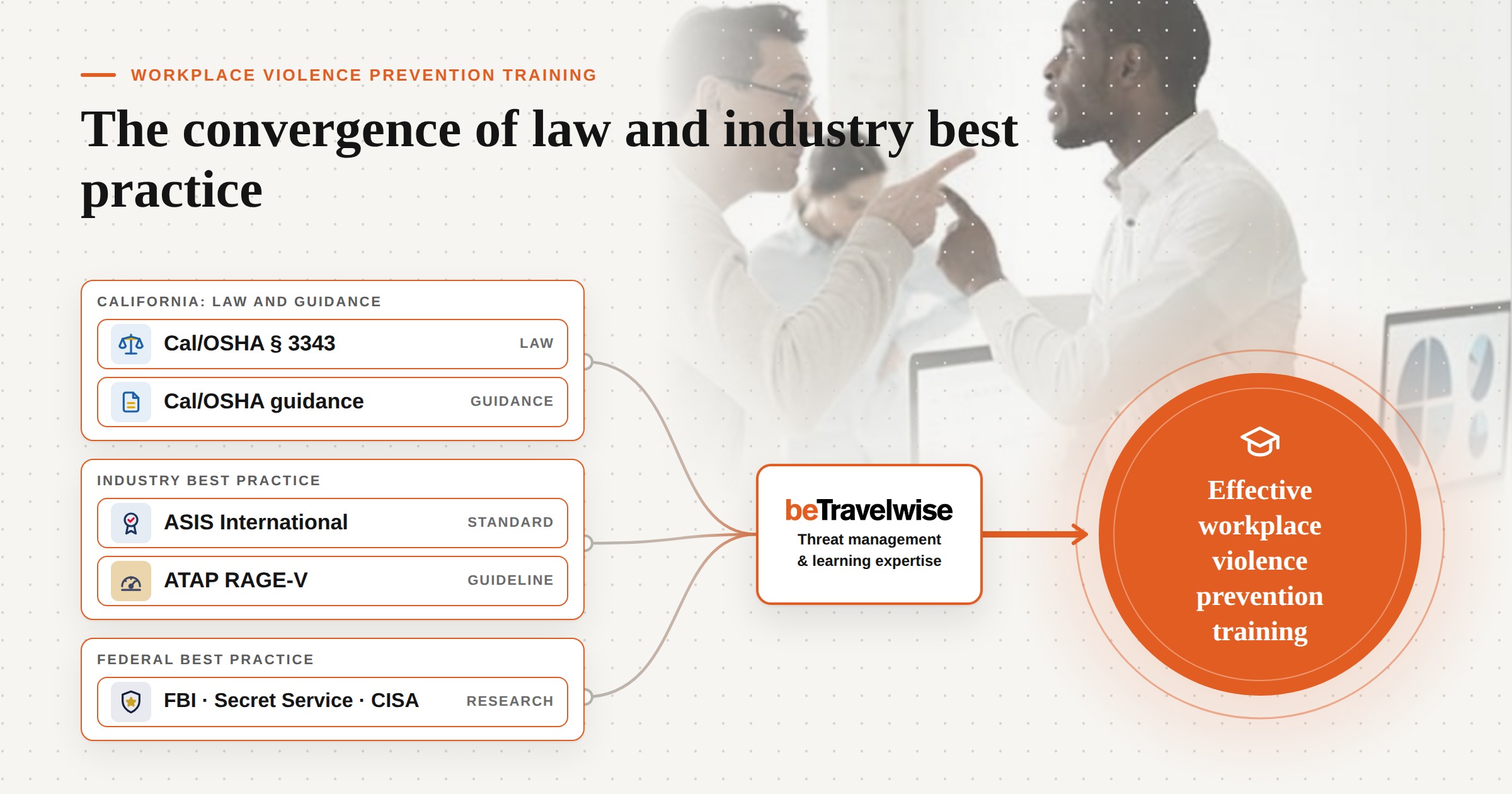
For security leaders responsible for their organization’s workplace violence prevention program, the next three months matter. California is about to adopt its detailed workplace violence regulation. ASIS and the Secret Service are both publishing major updates, and the FBI’s latest active shooter report is already out. It may be purely coincidental, but the timing means law, industry best practice and federal research are all changing at once, and together they raise the bar for training.
The law: Cal/OSHA § 3343
Draft regulation 8 CCR § 3343 will turn SB 553 into a detailed Cal/OSHA standard, which the Standards Board must adopt by December 31, 2026 (Cal/OSHA). The text may still change, and for organizations with established security programs much of it will look familiar, but it generally tightens the Plan. It defines workplace violence hazards more specifically, listing factors such as employees working alone, poor lighting and entry points where unauthorized access can occur. Employees must be able to report to someone other than their direct supervisor, they gain access to investigation records as well as the incident log, and the regulation extends to transportation the employer provides and controls, such as shuttles. Employers must also offer trauma counseling after an incident, although an employee assistance program satisfies this.
The training topics carry over from SB 553 almost unchanged, with one new rule: training not given in person must let employees ask questions and get an answer within one business day. That does not mean training can stay as it is. Employees must be trained on the Plan and all its elements, and on the regulation’s definitions and requirements, so any change an employee would reasonably need to know about has to be reflected in their training. Updated Cal/OSHA guidance for § 3343 will follow, as it did for SB 553, when the model plan appeared about six months after the law was signed. There is no guarantee the same timeline will apply this time.
Industry best practice: ASIS International
ASIS is replacing its current 2020 standard, ANSI/ASIS WVPI AA-2020, with a new Workplace Violence Prevention and Intervention Standard, which is ANSI-approved and due in early October 2026. It matters because it defines workplace violence more broadly than § 3343, as a spectrum of concerning behavior rather than physical threats alone, and puts early reporting at the center of prevention. Cal/OSHA does not enforce it, but as the leading consensus standard it is widely cited as evidence of what a reasonable employer should do.
Federal best practice: the Secret Service and FBI
On October 21, 2026, the Secret Service National Threat Assessment Center will publish Preventing Targeted Workplace Violence, its first guide written specifically for workplaces (Secret Service). It combines research on the backgrounds and behavior of workplace attackers with an eight-step framework for identifying, assessing and managing threats. The FBI’s latest active shooter report points the same way: 68 percent of 2025 shooters planned and prepared beforehand (FBI).
The shared message: targeted violence is rarely sudden, and understanding and reporting the warning signs gives organizations the chance to intervene.
Key dates
| Date | Milestone |
|---|---|
| Early October 2026 | New ASIS workplace violence standard published |
| October 21, 2026 | Secret Service workplace violence guide released |
| By early November 2026 | Formal notice of the final § 3343 proposal expected |
| December 31, 2026 | Deadline for the Standards Board to adopt § 3343 |
| TBC 2027 | § 3343 takes effect: Plans must meet the new requirements |
| TBC 2027 | Training on the Plan changes |
The dates that matter most, for updating Plans and training employees, will be confirmed once § 3343 is adopted. The first indication may come with the formal notice, expected by early November. We will share them as soon as they are known.
What comes next
We have already reviewed the draft § 3343 in detail for our clients, so our courses are ready for the likely changes. They already draw on the current ASIS standard and federal research, and we will cross-reference the new ASIS standard and Secret Service guide as they are published, updating our content wherever it strengthens the training.
This is the first in a short series. Our next update will follow in late October or early November, with a further update once the final § 3343 text and its dates are confirmed.
Want to get ahead of these changes, or see how your current training could be improved? Contact Andy Prior, CPP, Director, at andy@betravelwise.com.
29th September 2026


